Sunday, October 20, 2013

Philosophy of Life and Tolerance

 I know that the sun is really hot. I know that Socrates was killed for what he believed. I know that I was born and I will die for I am mortal. I know that I need food to survive. I know that Honduras is a country and that it is located in Central America. I believe that abortion is bad and/or wrong. I believe that every person has a purpose whether big or small. I believe in a Supreme Being, I 'know' that He exists but I cannot prove it to you therefore it becomes a belief. I believe that Mondays are the worst days of the week. (Deductive reasoning).
Some of the things that contribute to a person's philosophy on life would be their environment, where they live, have they moved, if so to where, etc. Their upbringing, how they were taught, who cared for them, what religion or values or morals surrounded them, etc. Their different experiences, if they came across a near death experience, whether they had a harmful or beneficial experience in their early childhood, teenage years, etc. Their social situations, where they are in society, whether they follow society or deviate from it, etc. (Inductive reasoning).
Conscience is the little voice in your head that tells you right from wrong, the gut feeling of wrong versus right. I think that conscience is innate, we are all born with it, but like Aristotle's innate reason, it is empty and as we grow and experience things we fill it up with knowledge of wrong and right. I think that it will change depending on the person and his or her beliefs of right or wrong. How we choose to use our conscience, whether we follow it or go against it is our choice. So conscience changes per person per culture, the idea conscience stays the same. (Inductive and Deductive reasoning).


 The priority values is when you have to choose between two values, which is “better.” for example, you have to choose between studying and watching Youtube videos, which will you choose? You have to find which of the two is a priority. If you have to choose between driving a car and polluting the air versus walking or riding a bike and having clean air, which would you choose? Which has a bigger priority? This will change per person and per culture, some may think it is better to drive a car to get to wherever faster while others will say that keeping the air clean is better. (Deductive reasoning and Inductive reasoning).

Thursday, October 17, 2013

Plato and Aristotle

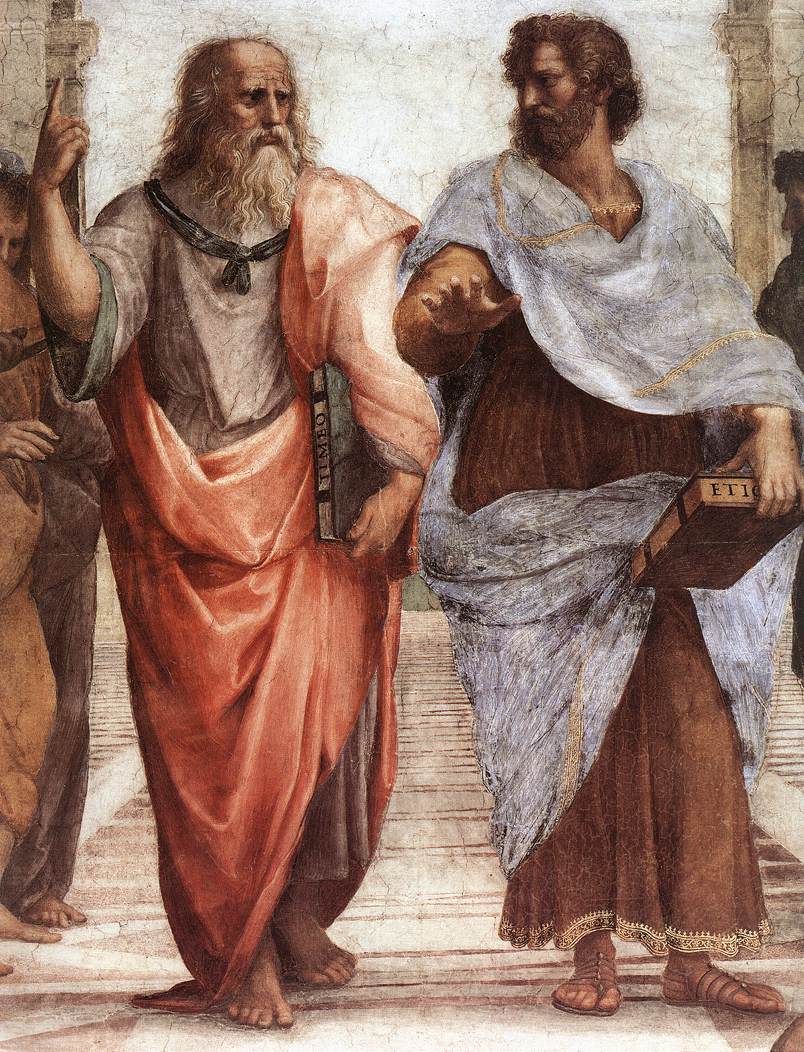
Plato and Aristotle are tow of the world's most influential philosophers. Both had completely different views on the world. They were complete opposites or binary opposites and with both views comes certain consequences.
Plato believed in innate ideas, he believed our souls lived in a World of Ideas, before it lived in our bodies, that's why when we see a 'table,' we know it's a 'table' for soul already saw the idea 'table' in the World of Ideas. He used more deductive reasoning to come to conclusions. He believed our souls are immortal. Now, if we choose to believe what Plato believed there are certain consequences. From this idea of souls being immortal and the World of Ideas, the idea of reincarnation could have been a product. For our soul never dies, it just has a new 'life' or body after our current body dies, according to Plato. From Plato the idea “soul mate” is formed, our soul was connected to another's in the World of Ideas, they were separated to be later joined again in the world we live in, in marriage. The idea that we already knew everything, we just lose it and we have to relearn it can also come from Plato's main idea or concept.
Aristotle believed in innate reason, he believed that we are all born with reason but it is empty and as we experience the world our reason fills. He believed that everything in nature has a purpose. He believed women were less than or equal to dogs. He used inductive reasoning to come to conclusions. He also believed that everything in life has a category or a place it can be placed/put. He also used logic to discover the unknown and through expPlato and Aristotle are tow of the world's most influential philosophers. Both had completely different views on the world. They were complete opposites or binary opposites and with both views comes certain consequences.
Plato believed in innate ideas, he believed our souls lived in a World of Ideas, before it lived in our bodies, that's why when we see a 'table,' we know it's a 'table' for soul already saw the idea 'table' in the World of Ideas. He used more deductive reasoning to come to conclusions. He believed our souls are immortal. Now, if we choose to believe what Plato believed there are certain consequences. From this idea of souls being immortal and the World of Ideas, the idea of reincarnation could have been a product. For our soul never dies, it just has a new 'life' or body after our current body dies, according to Plato. From Plato the idea “soul mate” is formed, our soul was connected to another's in the World of Ideas, they were separated to be later joined again in the world we live in, in marriage. The idea that we already knew everything, we just lose it and we have to relearn it can also come from Plato's main idea or concept.
Aristotle believed in innate reason, he believed that we are all born with reason but it is empty and as we experience the world our reason fills. He believed that everything in nature has a purpose. He believed women were less than or equal to dogs. He used inductive reasoning to come to conclusions. He also believed that everything in life has a category or a place it can be placed/put. He also used logic to discover the unknown and through experience we gain knowledge. If we choose to believe in what Aristotle believed we have another list of consequences. From Aristotle we have categories for pretty much everything; socks go in a sock drawer, dresses are hung up in the closet, jeans go in the jean drawer. We also have categories for all living things: domain, kingdom, phylum, class, order, family, genus, species, this categorization was created by Linnaeus, but was most likely inspired by Aristotle. We can get the idea of purpose from Aristotle, for example, why does it rain? To water plants to feed animals and humans is the answer Aristotle would have given. We can get the idea of sexism, masculinism, and feminism where men think they are better than women or women are better than men, from the idea of women being less than or equal to dogs. We get the saying or concept of “experience is the bets teacher.” We can also take scientists who use logic to discover the unknown like Aristotle, there are many people who use logic to discover the unknown.
As can be seen, Aristotle and Plato think differently, they are binary opposites. Out of each thought though comes a consequence, from either side, deeds were done based upon or influenced by these philosophic ideas. They are two of the world's most influential philosophers and hopefully now we can see why.erience we gain knowledge. If we choose to believe in what Aristotle believed we have another list of consequences. From Aristotle we have categories for pretty much everything; socks go in a sock drawer, dresses are hung up in the closet, jeans go in the jean drawer. We also have categories for all living things: domain, kingdom, phylum, class, order, family, genus, species, this categorization was created by Linnaeus, but was most likely inspired by Aristotle. We can get the idea of purpose from Aristotle, for example, why does it rain? To water plants to feed animals and humans is the answer Aristotle would have given. We can get the idea of sexism, masculinism, and feminism where men think they are better than women or women are better than men, from the idea of women being less than or equal to dogs. We get the saying or concept of “experience is the bets teacher.” We can also take scientists who use logic to discover the unknown like Aristotle, there are many people who use logic to discover the unknown.

As can be seen, Aristotle and Plato think differently, they are binary opposites. Out of each thought though comes a consequence, from either side, deeds were done based upon or influenced by these philosophic ideas. They are two of the world's most influential philosophers and hopefully now we can see why.  

Wednesday, October 16, 2013

The Matrix Comparison

The Matrix has many different philosophical concepts that make it a great movie for entertainment and for deep thought. The Matrix has many similarities with The Adventure of the Hero. It also has many similarities with the Allegory of the Cave and with Plato. And these, Adventure, Matrix, Cave, and Plato, all connect with each other.
We start with The Matrix and The Adventure of the Hero by Joseph Campbell. The hero goes on a journey or an adventure and in The Matrix, Neo is the hero. Neo is called to be the hero, he refuses, he then accepts, and viola his adventure starts. The hero that Joseph Campbell also goes through these steps in a much more detailed version, he came up with the conclusion that every hero goes through these steps, maybe not all exactly, maybe sometimes adding steps or taking away some steps or having the steps in a different order. So Neo is our hero and he must go through trials and fights or battles, he meets a goddess, Trinity, he gains full power and knowledge at the end of the movie, he is a classic example of the Hero. Thor is another example of the Hero story, especially with the scene where he appears to have died and his hammer flies to him and he comes back as the mighty Thor. This goes along with the Adventure of the Hero, where the hero appears to have died and some outside force helps him and he comes back to conquer the world.
We then have the Allegory of the Cave which Plato drew and created as a theory of how ordinary people are versus philosophers. The ordinary people are chained to a wall without being able to turn around, they can only see shadows in front of them of objects behind them that they do not know about. Now the philosopher would be the one person that becomes unchained and sees the real objects, he explores and finds the entrance/exit to the cave, he goes out and is in utter awe of what he sees. In The Matrix, Neo is reborn in the vat of pink goo. He becomes unchained or unhooked from the tubes and he sees all around him, the billions of other vats. He is in utter awe of what he sees. He would be the philosopher when compared with the Allegory of the Cave. In Batman The Dark Knight Rises, when Batman climbs out of the prison he was in and he is in awe of what he did, it would kind of be like the Cave for Batman climbs out of the pit of imprisonment, the philosopher getting unchained. He is in awe of his surroundings and what he accomplished, when the philosopher exits the cave and sees all the beauty of the world.
Plato had many different beliefs and concepts. One of his concepts was the World of Ideas, he believed that there is another world where ideas are and our soul lives there before it is placed inside our body. He believed that when we are then born our soul knows what a table is because the soul knew it in the other world. He was the student of Socrates and he was the one that wrote all of Socrates' discussions. The way Plato can connect with The Matrix is where Plato wrote about Socrates' life, and Neo's life was a little like Socrates, when he was born, and as he grew, he knew there was something wrong with the world and he wanted to find out what was wrong. Neo then discovers the Matrix, he is born again and is in awe of this world he knew was there but didn't see, he later tries to tell others of the Matrix. This is very much like Socrates, who always tried to make people think, he was trying to prove that man cannot possibly know everything, he would make the smartest man feel stupid. The bug difference is that Socrates was killed for speaking out philosophically while Neo was not killed.
Plato and the Hero story relate to each other for Plato's Socrates was like the hero. Socrates was the hero that Joseph Campbell wrote about. Now not all the steps are the same for Socrates dies at the end for what he believes, but it is quite similar. The hero's journey is like Socrates' journey trying to teach others and to make them think.
Now Plato and the Allegory of the Cave relate for Plato gave the concept of the Allegory of the Cave, he drew it, he thought of it, he created it. Plato just created it in Socrates' written mouth, so it looked like Socrates told his class about it even though Plato did.
The Adventure of the Hero and the Allegory of the Cave connect for the hero goes through a rebirth, he becomes a hero, he does something, he returns, he tries to help people in the old world. The philosopher that is unchained is the hero for he is reborn, he is in awe of all he sees, what he has seen all his life was false, it was merely shadows, he does something; he acquires knowledge, he returns, the only difference is that the philosopher is supposed to die at the end while the hero does not. Other than that they connect quite well.


In conclusion, we can see that The Matrix is similar to Plato, The Adventure of the Hero, and the Allegory of the Cave. We can also see that Plato connects with The Adventure of the Hero, the Allegory of the Cave, and of course The Matrix. We also saw the connection between The Adventure of the Hero with the Allegory of the Cave, The Matrix and Plato. And lastly we saw the Allegory of the Cave connect with The Matrix, Plato, and The Adventure of the Hero.