Sunday, December 8, 2013

Rationalism vs. Empiricism

                Rationalists and Empiricists are two different forms of philosophy that came about in Ancient Greece and is still both are used in the Enlightenment. Rationalism came first followed by Empiricism. Both sides have their main representatives. For rationalism we have Spinoza and Descartes. For empiricism we have Hume, Locke and Berkeley. Rationalism and Empiricism can be considered as binary opposites.
                Rationalists, Spinoza and Descartes, had their differences but both used their reason to come to their conclusions. Descartes was a system-builder, who doubted everything except that he was real/existing because as he said, “I think, therefore I am.” Descartes also separated the mind and body and said that God must exist because humans can think of a perfect being and only a perfect being can place that thought in human brains/thought.  Spinoza had no separation between mind and body and he was a pantheist, where he believed that everything was in God and God was in everything. He also had a perspective of eternity.
                Empiricists, Hume, Locke, and Berkeley, also had their differences but used their senses to come to come to conclusions. Hume believed in impressions and ideas, he thought people needed to sharpen their awareness and he used is senses to conclude. Locke said concepts are formed through the senses and he believed in sensations and ideas. Berkeley said that all we perceive is made of God, and the only things that exist are those things which we perceive. He also said that we do not perceive ‘material’ or ‘matter.’
               
Rationalists come to their conclusions through thought and reasoning, they do not rely on their senses, solely on reason. They say “essence precedes existence,” meaning that the idea or what the thing is made of, comes before its existence. A lot of physicians and mathematicians are considered rationalists, like Einstein. Empiricists, however, come to their conclusions using their senses and/or emotions/sentiments. They say “existence precedes essence,” meaning that a thing must exist before the idea or what it is made of. Experimental scientists are considered empiricist because of using experience/experiments/senses.

                In conclusion, rationalists and empiricists differ in their beliefs and philosophizing methods. So, what motivates you more: universal principles or senses/emotions/sentiments? I would say my emotions motivate me more, because it is more individual and relates to me, some things I may want to do because I enjoy them, I’m not going to do something I don’t like, even though someone else may like what I dislike. Also, a universal principle may change and when put into a situation I might not think of a principle (right or wrong) I’ll just act based on my feelings. Thirdly, as I grow older, my emotions/sentiments/senses can change, as well as how I feel/believe in a universal principle. I do think that for me a universal principle may motivate me, but as using the adjective ‘more.’ I’d say my senses/emotions/sentiments do. This thought makes me more empiricist than rationalist, for my senses or emotions would motivate me more than my reason or universal principles. 

Saturday, November 30, 2013

Descartes and Spinoza

                Rationalism is the ability to use reason and deep thought to come to a conclusion. Descartes and Spinoza go back to Parmenides with their thoughts of reason being more important than the senses. Descartes and Spinoza had their differences but they both shared the idea of rationalizing to come to their conclusions. This somewhat new idea of reasoning and starting from the ground up influenced philosophy. These two philosophers influenced philosophy in a major way with this new way of thinking.
             
   Descartes is considered the father of modern philosophy; he was also the first significant system-builder. This idea of system-building, started with Descartes doubting everything, he started from the ground and built from there. He was considered a rationalist because he didn’t just find answers, he dug deep, doubted everything, and then with his reason he came to his conclusions. He was also considered a rationalist for his new method for solving a philosophical problem/question. As stated before, Descartes doubted everything, however, there was one thing he was certain of: he came to the conclusion that because he thinks he therefore exists. Along these same lines, he came up with a way to “prove” God existed, by saying that because we can think of the idea perfect and because we can create an idea of God, only a perfect being or God could have placed that thought there.
                Spinoza was the first to apply a historic-critical interpretation of the Bible. He took apart the Bible and examined each part, he started from the bottom and went from there, and this is one of the reasons why he is considered a rationalist.  He also geometrically demonstrated ethics; he took apart ethics and started again. He is also considered a rationalist because of his way of breaking apart a certain topic and examining each piece part. He would then use reason and deep thought to come to conclusion.
                Both philosophers started from the ground and built from there. They both used deep thought and cogitate to come up with their conclusions. Both differed from the other in terms of what they chose to break down and analyze and later on conclude, but they both shared this title of rationalist. These two had a great impact on modern philosophy, for now most philosophers start from the bottom and grow with their ideas and conclusions, from the ground up. They both used Parmenides to start their method of philosophizing and then in modern philosophy we have this idea being used again.

                Rationalism is the ability to use reason and deep thought to come to a conclusion. Descartes and Spinoza go back to Parmenides with their thoughts of reason being more important than the senses. Descartes and Spinoza had their differences but they both shared the idea of rationalizing to come to their conclusions. This somewhat new idea of reasoning and starting from the ground up influenced philosophy. These two philosophers influenced philosophy in a major way with this new way of thinking. I never knew that rationalizing could have been so important to philosophy; I knew it was an important part but I didn’t know that it is such a key part in it. I didn’t know that Descartes is considered a father of modern philosophy nor that he was the first to system-build from the ground up, for now so many people start from the ground up that it became a cliché. 

Tuesday, November 19, 2013

The Two Cultures, Middle Ages, Renaissance, and Baroque

Throughout history we have many different time periods and the reason they are split into periods is because of the difference in beliefs and ideas. We have four different time periods that will be discussed; we have the Two Cultures, the Middle Ages, the Renaissance, and the Baroque time periods. All four periods have different ideas and concepts.

In the first chapter on the Two Cultures we see two different cultures which believed different things. We first have the Indo-Europeans who believed that sight was the most important sense. They practiced polytheism, the belief in many gods. They also had a cyclic view on history. The second culture was the Semites who believed that hearing was the most important sense. They practiced monotheism, the belief in one God. They had a linear view on history. Both cultures were close together in time and geographically but they believed two separate things. Ideas are constantly changing and evolving, we can see this here where two very close cultures believe almost opposite of each other. We have contrasting ideas in the same period of time.
In the chapter on the Middle Ages we learn a couple new philosophical ideas/concepts. During the Middle Ages we have St. Augustine who was a Platonist and he was also the person who christianized Plato. We then have St. Thomas Aquinas who christianized Aristotle. Both revolutionized the concept of Christianity. They both gave a logic to Christianity as well. A lot of medieval philosophers took for granted that Christianity was true, and both of these St./philosophers above answered the burning question of whether we must simply believe the Christian revelation or whether we can approach the Christian truths with the help of reason. As we can see, another set of contrasting ideas, but this time the ideas were used in the same way for the same purpose. So we see how two ideas are opposite each other but are occurring during the same time period.
In the chapter on the Renaissance we have some new ideas coming forth. The Renaissance was a time of rebirth, holes or cracks started to appear in the unifying culture of Christianity. During this time, a shift in thought occurred. People started reasoning and thinking for themselves. The ideas of individualism and humanism came into play. Science advanced, along with technology and knowledge. We have a new world view, a transition that is breaking away from the old ways of thinking. Man become valuable and unique. Pantheism, which is the idea that is God is infinite He must be present in everything, became popular. During this time knowledge equaled power. Scientists performed experiments and a heliocentric world picture is put into play. This period exploded with new ideas and new ways of doing things, it was a “rebirth” of ideas/thoughts/concepts. In this period of time we don't have contrasting ideas, but we have an explosion of multiple new ideas. We see how thinking changed from the Two Culture's time and this time. We have new ideas ranging from science to literature to art to philosophy, not contrasting but rather a variety of new ideas.
The last chapter which is about the Baroque, we see, again, new ideas unfold. Baroque means “a pearl of irregular shape” and during this period we have irregularity . We have a dualistic point of view: we now have a “mechanistic universe” and from this we have two separate reactions. One reaction is that of flamboyancy where we have wit and fun and we have total freedom, so what do you do? We have materialism and the idea that man is a machine, the mechanistic universe is a clock. The second reaction is one of piety where we have an obsession with death and the idea of idealism, we have absolute monarchy and everything is a product of mechanical processes. We have Shakespeare with “To be or not to be,” and the idea that life is an illusion, a dream, and it is short. In this period of time we have two ideas coming from the same source, but they both contrast each other, they are the complete opposite of the other. In the same period we have to extremes colliding with each other.

As can be seen we have four different periods and during each period we have different ideas and concepts. We have an evolving want to question and to find answers. Through each period we see this evolution of ideas and it propels us forward. We see how ideas in the same period can contrast each other, but with the contrasting force we also have a force that propels us forward and still in this day and age we have contrasting ideas that push us to go on.  

Sunday, October 20, 2013

Philosophy of Life and Tolerance

 I know that the sun is really hot. I know that Socrates was killed for what he believed. I know that I was born and I will die for I am mortal. I know that I need food to survive. I know that Honduras is a country and that it is located in Central America. I believe that abortion is bad and/or wrong. I believe that every person has a purpose whether big or small. I believe in a Supreme Being, I 'know' that He exists but I cannot prove it to you therefore it becomes a belief. I believe that Mondays are the worst days of the week. (Deductive reasoning).
Some of the things that contribute to a person's philosophy on life would be their environment, where they live, have they moved, if so to where, etc. Their upbringing, how they were taught, who cared for them, what religion or values or morals surrounded them, etc. Their different experiences, if they came across a near death experience, whether they had a harmful or beneficial experience in their early childhood, teenage years, etc. Their social situations, where they are in society, whether they follow society or deviate from it, etc. (Inductive reasoning).
Conscience is the little voice in your head that tells you right from wrong, the gut feeling of wrong versus right. I think that conscience is innate, we are all born with it, but like Aristotle's innate reason, it is empty and as we grow and experience things we fill it up with knowledge of wrong and right. I think that it will change depending on the person and his or her beliefs of right or wrong. How we choose to use our conscience, whether we follow it or go against it is our choice. So conscience changes per person per culture, the idea conscience stays the same. (Inductive and Deductive reasoning).


 The priority values is when you have to choose between two values, which is “better.” for example, you have to choose between studying and watching Youtube videos, which will you choose? You have to find which of the two is a priority. If you have to choose between driving a car and polluting the air versus walking or riding a bike and having clean air, which would you choose? Which has a bigger priority? This will change per person and per culture, some may think it is better to drive a car to get to wherever faster while others will say that keeping the air clean is better. (Deductive reasoning and Inductive reasoning).

Thursday, October 17, 2013

Plato and Aristotle

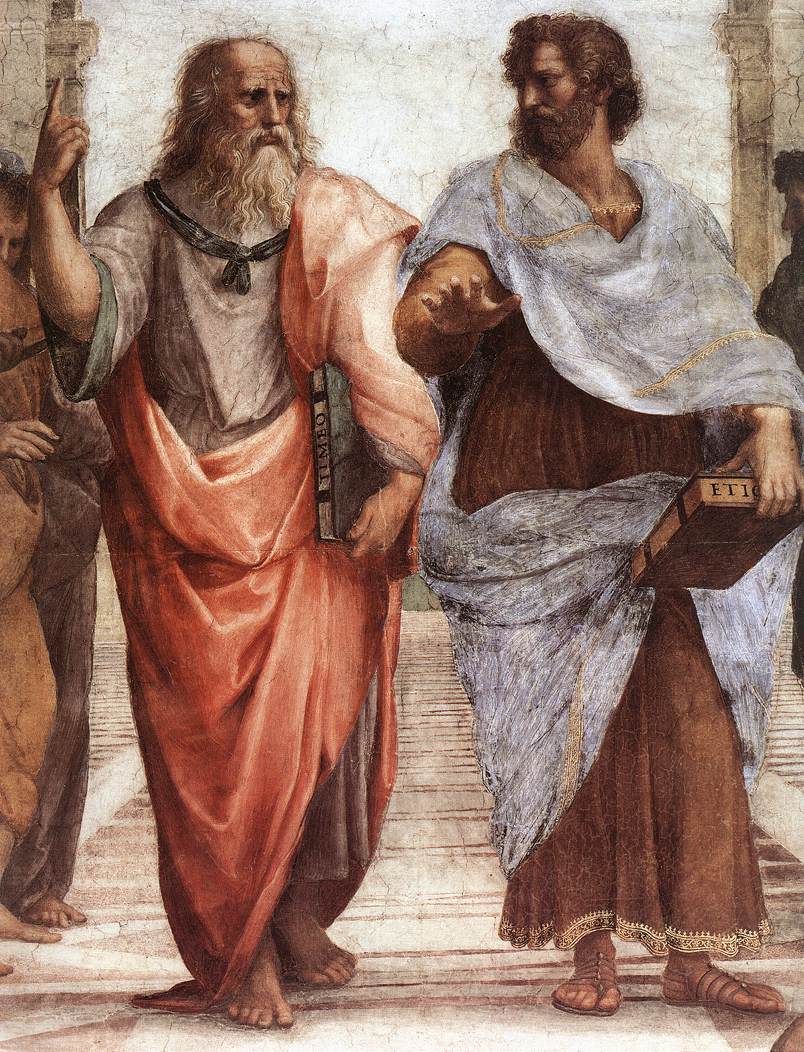
Plato and Aristotle are tow of the world's most influential philosophers. Both had completely different views on the world. They were complete opposites or binary opposites and with both views comes certain consequences.
Plato believed in innate ideas, he believed our souls lived in a World of Ideas, before it lived in our bodies, that's why when we see a 'table,' we know it's a 'table' for soul already saw the idea 'table' in the World of Ideas. He used more deductive reasoning to come to conclusions. He believed our souls are immortal. Now, if we choose to believe what Plato believed there are certain consequences. From this idea of souls being immortal and the World of Ideas, the idea of reincarnation could have been a product. For our soul never dies, it just has a new 'life' or body after our current body dies, according to Plato. From Plato the idea “soul mate” is formed, our soul was connected to another's in the World of Ideas, they were separated to be later joined again in the world we live in, in marriage. The idea that we already knew everything, we just lose it and we have to relearn it can also come from Plato's main idea or concept.
Aristotle believed in innate reason, he believed that we are all born with reason but it is empty and as we experience the world our reason fills. He believed that everything in nature has a purpose. He believed women were less than or equal to dogs. He used inductive reasoning to come to conclusions. He also believed that everything in life has a category or a place it can be placed/put. He also used logic to discover the unknown and through expPlato and Aristotle are tow of the world's most influential philosophers. Both had completely different views on the world. They were complete opposites or binary opposites and with both views comes certain consequences.
Plato believed in innate ideas, he believed our souls lived in a World of Ideas, before it lived in our bodies, that's why when we see a 'table,' we know it's a 'table' for soul already saw the idea 'table' in the World of Ideas. He used more deductive reasoning to come to conclusions. He believed our souls are immortal. Now, if we choose to believe what Plato believed there are certain consequences. From this idea of souls being immortal and the World of Ideas, the idea of reincarnation could have been a product. For our soul never dies, it just has a new 'life' or body after our current body dies, according to Plato. From Plato the idea “soul mate” is formed, our soul was connected to another's in the World of Ideas, they were separated to be later joined again in the world we live in, in marriage. The idea that we already knew everything, we just lose it and we have to relearn it can also come from Plato's main idea or concept.
Aristotle believed in innate reason, he believed that we are all born with reason but it is empty and as we experience the world our reason fills. He believed that everything in nature has a purpose. He believed women were less than or equal to dogs. He used inductive reasoning to come to conclusions. He also believed that everything in life has a category or a place it can be placed/put. He also used logic to discover the unknown and through experience we gain knowledge. If we choose to believe in what Aristotle believed we have another list of consequences. From Aristotle we have categories for pretty much everything; socks go in a sock drawer, dresses are hung up in the closet, jeans go in the jean drawer. We also have categories for all living things: domain, kingdom, phylum, class, order, family, genus, species, this categorization was created by Linnaeus, but was most likely inspired by Aristotle. We can get the idea of purpose from Aristotle, for example, why does it rain? To water plants to feed animals and humans is the answer Aristotle would have given. We can get the idea of sexism, masculinism, and feminism where men think they are better than women or women are better than men, from the idea of women being less than or equal to dogs. We get the saying or concept of “experience is the bets teacher.” We can also take scientists who use logic to discover the unknown like Aristotle, there are many people who use logic to discover the unknown.
As can be seen, Aristotle and Plato think differently, they are binary opposites. Out of each thought though comes a consequence, from either side, deeds were done based upon or influenced by these philosophic ideas. They are two of the world's most influential philosophers and hopefully now we can see why.erience we gain knowledge. If we choose to believe in what Aristotle believed we have another list of consequences. From Aristotle we have categories for pretty much everything; socks go in a sock drawer, dresses are hung up in the closet, jeans go in the jean drawer. We also have categories for all living things: domain, kingdom, phylum, class, order, family, genus, species, this categorization was created by Linnaeus, but was most likely inspired by Aristotle. We can get the idea of purpose from Aristotle, for example, why does it rain? To water plants to feed animals and humans is the answer Aristotle would have given. We can get the idea of sexism, masculinism, and feminism where men think they are better than women or women are better than men, from the idea of women being less than or equal to dogs. We get the saying or concept of “experience is the bets teacher.” We can also take scientists who use logic to discover the unknown like Aristotle, there are many people who use logic to discover the unknown.

As can be seen, Aristotle and Plato think differently, they are binary opposites. Out of each thought though comes a consequence, from either side, deeds were done based upon or influenced by these philosophic ideas. They are two of the world's most influential philosophers and hopefully now we can see why.  

Wednesday, October 16, 2013

The Matrix Comparison

The Matrix has many different philosophical concepts that make it a great movie for entertainment and for deep thought. The Matrix has many similarities with The Adventure of the Hero. It also has many similarities with the Allegory of the Cave and with Plato. And these, Adventure, Matrix, Cave, and Plato, all connect with each other.
We start with The Matrix and The Adventure of the Hero by Joseph Campbell. The hero goes on a journey or an adventure and in The Matrix, Neo is the hero. Neo is called to be the hero, he refuses, he then accepts, and viola his adventure starts. The hero that Joseph Campbell also goes through these steps in a much more detailed version, he came up with the conclusion that every hero goes through these steps, maybe not all exactly, maybe sometimes adding steps or taking away some steps or having the steps in a different order. So Neo is our hero and he must go through trials and fights or battles, he meets a goddess, Trinity, he gains full power and knowledge at the end of the movie, he is a classic example of the Hero. Thor is another example of the Hero story, especially with the scene where he appears to have died and his hammer flies to him and he comes back as the mighty Thor. This goes along with the Adventure of the Hero, where the hero appears to have died and some outside force helps him and he comes back to conquer the world.
We then have the Allegory of the Cave which Plato drew and created as a theory of how ordinary people are versus philosophers. The ordinary people are chained to a wall without being able to turn around, they can only see shadows in front of them of objects behind them that they do not know about. Now the philosopher would be the one person that becomes unchained and sees the real objects, he explores and finds the entrance/exit to the cave, he goes out and is in utter awe of what he sees. In The Matrix, Neo is reborn in the vat of pink goo. He becomes unchained or unhooked from the tubes and he sees all around him, the billions of other vats. He is in utter awe of what he sees. He would be the philosopher when compared with the Allegory of the Cave. In Batman The Dark Knight Rises, when Batman climbs out of the prison he was in and he is in awe of what he did, it would kind of be like the Cave for Batman climbs out of the pit of imprisonment, the philosopher getting unchained. He is in awe of his surroundings and what he accomplished, when the philosopher exits the cave and sees all the beauty of the world.
Plato had many different beliefs and concepts. One of his concepts was the World of Ideas, he believed that there is another world where ideas are and our soul lives there before it is placed inside our body. He believed that when we are then born our soul knows what a table is because the soul knew it in the other world. He was the student of Socrates and he was the one that wrote all of Socrates' discussions. The way Plato can connect with The Matrix is where Plato wrote about Socrates' life, and Neo's life was a little like Socrates, when he was born, and as he grew, he knew there was something wrong with the world and he wanted to find out what was wrong. Neo then discovers the Matrix, he is born again and is in awe of this world he knew was there but didn't see, he later tries to tell others of the Matrix. This is very much like Socrates, who always tried to make people think, he was trying to prove that man cannot possibly know everything, he would make the smartest man feel stupid. The bug difference is that Socrates was killed for speaking out philosophically while Neo was not killed.
Plato and the Hero story relate to each other for Plato's Socrates was like the hero. Socrates was the hero that Joseph Campbell wrote about. Now not all the steps are the same for Socrates dies at the end for what he believes, but it is quite similar. The hero's journey is like Socrates' journey trying to teach others and to make them think.
Now Plato and the Allegory of the Cave relate for Plato gave the concept of the Allegory of the Cave, he drew it, he thought of it, he created it. Plato just created it in Socrates' written mouth, so it looked like Socrates told his class about it even though Plato did.
The Adventure of the Hero and the Allegory of the Cave connect for the hero goes through a rebirth, he becomes a hero, he does something, he returns, he tries to help people in the old world. The philosopher that is unchained is the hero for he is reborn, he is in awe of all he sees, what he has seen all his life was false, it was merely shadows, he does something; he acquires knowledge, he returns, the only difference is that the philosopher is supposed to die at the end while the hero does not. Other than that they connect quite well.


In conclusion, we can see that The Matrix is similar to Plato, The Adventure of the Hero, and the Allegory of the Cave. We can also see that Plato connects with The Adventure of the Hero, the Allegory of the Cave, and of course The Matrix. We also saw the connection between The Adventure of the Hero with the Allegory of the Cave, The Matrix and Plato. And lastly we saw the Allegory of the Cave connect with The Matrix, Plato, and The Adventure of the Hero.

Tuesday, August 27, 2013

Mythology and Religion

Mythology and religion are always considered opposites, by religious and non-religious people. There are some similarities between the two. For mythology and religion are very similar to each other, they both have stories or parables to teach the people about the world. They both answer, whether correctly or incorrectly, the questions most asked about ourselves and the world around us. They also use rituals to accomplish different things, mainly to have the person become part of the 'cult' or to have the person become new, but
mainly that a transformation occurs.
In the book, The Case For God, it says, “[myths] were designed to help people negotiate the obscure regions of the psyche...” All the Greek myths were used to help the Greek people acknowledge how the world came into being, as described in The Primary Myths. In order to teach the people about an idea, they used stories. In the Bible, Jesus used parables (stories) to illustrate a certain topic, like The Good Samaritan. He was teaching the people a concept that would have been hard to grasp without the story's illustration. In The Thoughts of Brahma, the Hindu religion gives a visual representation of how the world came to be. It answered a question that people, for ages, have been trying to answer. Why stories though? Why does every religion and every mythology use stories to say something? Because, stories are easy to understand, they are fun to listen to, they are simple, and because language is so important to human societies, they are part of our everyday life. We use stories to teach morals to little children, like The Little Red Hen. We use stories to answer children's questions of “why?” Religion uses stories to illustrate a moral or a religious concept so that adults, whom only think logically, and children, whom can't think logically, can both understand. Mythology does the same thing, for stories are the easiest things to remember. For example, everyone knows the story of Beauty and the Beast, there are may be a thousand different versions but everyone gets the same message out of it. Mythology and religion have many different versions of the same principle, the most known is how the world came to be. There are many different ways that people believe the world came to be, but all versions are somewhat similar in context and all are stories.

The second way religion and mythology are similar is how both answer the questions of the world. How did the Earth become the Earth? Why am I here? Who am I? Mythology tries to answer those questions using stories, as stated above, but still it tries to give the best possible answer to the hardest questions in life. Religion does the same. In Sophie's World, Sophie gets these strange letters asking her who she is and how the world came to be. Sophie didn't know, so she started to make a story to explain to herself how the world became the world. If Sophie religious, she would have turned to religion to look for an answer. In the Bible she would have found the Creation story, how the earth was created in seven days and man made in God's image, etc. In the Hindu scriptures she would have found the story of Brahma. If she believed that the old Greek myths or any old mythology were true , she would turn to mythology for answers and she would find the myth of The Birth of the Gods. But either way she turned, she would find answers, whether wrong or right, they were still answers. In the Sacred and Profane, it was discussing the idea of “Chaos and Cosmos,” and here it was saying that “our world” must be “created.” There are many different questions to life and mythology and religion try to answer them.

Lastly, religion and mythology use rituals to achieve something. As seen in the movie, “The Cave of Forgotten Dreams,” we see that the cavemen performed a ritual for boys to become men. This ritual creates a new being, a man out of a boy. In the Bible, when a person accepts Jesus into their hearts, they are born again. When a hero in Greek mythology went through a tribulation and came out on the other side victorious, he had to go through a ritual to achieve that status of hero. In the Sacred and Profane, it talked about a certain Vedic ritual, when someone wanted land he would build a fire altar in order to establish it legally and the fire altar was a communication with the gods, it also represented creation. Rituals were used and still are to ensure that a person's commitment was ensured, now religion has more rituals than mythology did/does, but they both still have rituals that ensured transformation between one stage to the next of a person's life.


Mythology and religion are very similar, they share many similar traits. Religion and mythology use stories to teach people certain things. Religion and mythology answer, whether correct or incorrectly, the questions of life. And lastly religion and mythology use rituals to ensure some type transformation in a person's life. These two topics, considered opposites, have more similarities than you would think. These are only a couple of the similarities, there are probably many more than those mentioned.